
Looking for a hands-on activity that combines fun and learning? The baking soda and vinegar balloon experiment is a classic science demonstration that’s perfect for kids, classrooms, or curious minds of all ages. With just a few simple household items, you can create a chemical reaction that fills a balloon with carbon dioxide gas—right before your eyes.
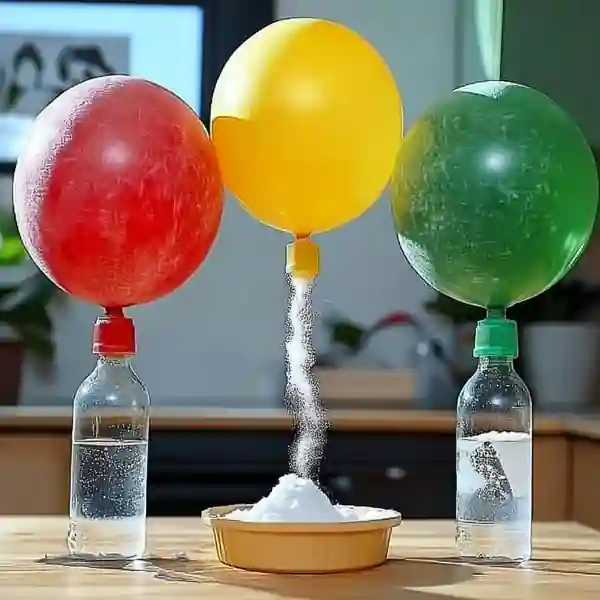
This project is not only exciting but also educational, offering a great opportunity to discuss scientific concepts such as gas formation, chemical reactions, and even the basics of pressure and volume. Let’s explore how this experiment works and how to make it a memorable learning moment.
The Science Behind the Fun
What Makes the Balloon Inflate?
At the heart of this experiment is a chemical reaction between baking soda (a base) and vinegar (an acid). When the two substances mix, they create carbon dioxide gas. This gas expands and needs somewhere to go, and since the bottle is sealed with a balloon, the balloon begins to inflate.
The balanced chemical equation for the reaction is:
NaHCO₃ (baking soda) + CH₃COOH (vinegar) → CO₂ (gas) + H₂O (water) + NaCH₃COO (sodium acetate)
This is a simple yet powerful demonstration of how chemical reactions produce gases, making science visually interactive and understandable.
Educational Value and Engagement
This experiment is more than just a visual treat. It introduces key scientific concepts in an easy-to-understand way. Teachers can use it to explain:
- The difference between physical and chemical changes
- The concept of gas production
- Pressure and containment
- Reaction rates depending on quantities
You can even turn it into a mini-scientific investigation by varying the ingredients and recording how the balloon size changes.
Supplies and Step-by-Step Guide
Ingredients
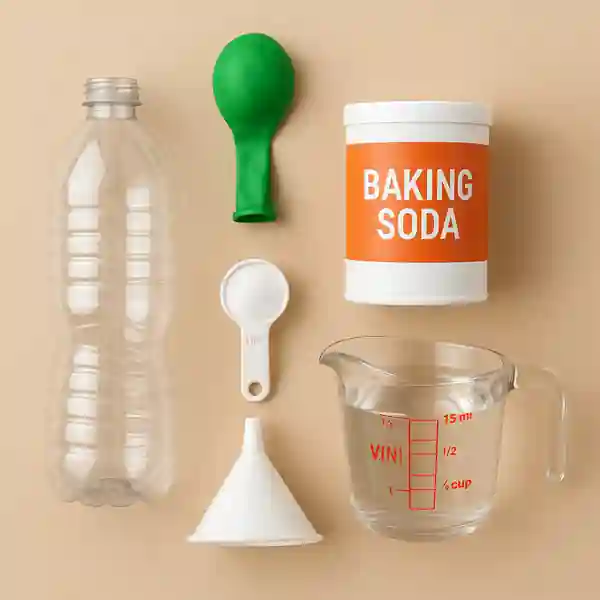
You’ll need the following materials:
- 1 empty plastic bottle (12 to 16 ounces)
- 1 balloon
- 2 to 3 tablespoons of baking soda
- 1/2 cup vinegar
- 1 small funnel or paper cone
- Measuring spoons and cup
Directions
Follow these steps to conduct the experiment safely and successfully:
- Fill the Balloon
Using a funnel, carefully pour 2 to 3 tablespoons of baking soda into the balloon. Tap it gently so the baking soda settles inside the balloon. - Prepare the Vinegar
Take the empty plastic bottle and pour in 1/2 cup of vinegar. - Attach the Balloon
Without spilling the baking soda into the bottle, stretch the balloon’s opening over the mouth of the bottle. Make sure it’s securely fastened so no gas escapes. - Initiate the Reaction
Hold the balloon upright to allow the baking soda to fall into the vinegar inside the bottle. Watch as the reaction begins immediately. - Observe the Inflation
As the carbon dioxide gas forms, it fills the balloon, causing it to inflate. You may hear fizzing or bubbling—this is the gas escaping from the liquid. - Experiment and Record
Try varying the amount of vinegar or baking soda to see how the balloon size changes. Encourage children to take notes and make hypotheses.
Tips, Tricks, and Variations
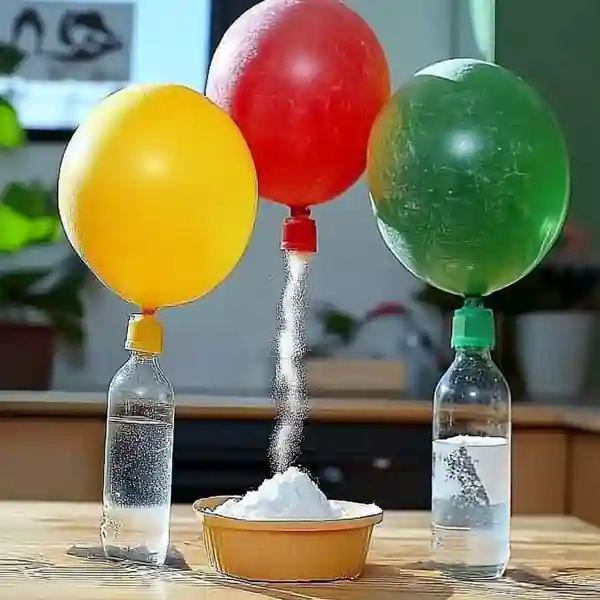
Make It More Visual
Want to add a splash of color to the experiment? Add a few drops of food coloring to the vinegar before starting. As the balloon inflates, you’ll get a colorful show, making it even more engaging for young scientists.
For a spooky Halloween twist, use an orange balloon and green food coloring—instant science fun with a seasonal flair!
Turn It Into a Teaching Moment
If you’re working with children or students, use this opportunity to talk about chemical reactions and the formation of gases. Ask questions like:
- What do you think will happen when the baking soda falls into the vinegar?
- Why does the balloon inflate?
- What could happen if we use more baking soda?
Encourage them to predict, observe, and reflect—key steps in the scientific method.







Love it. Will do with kids